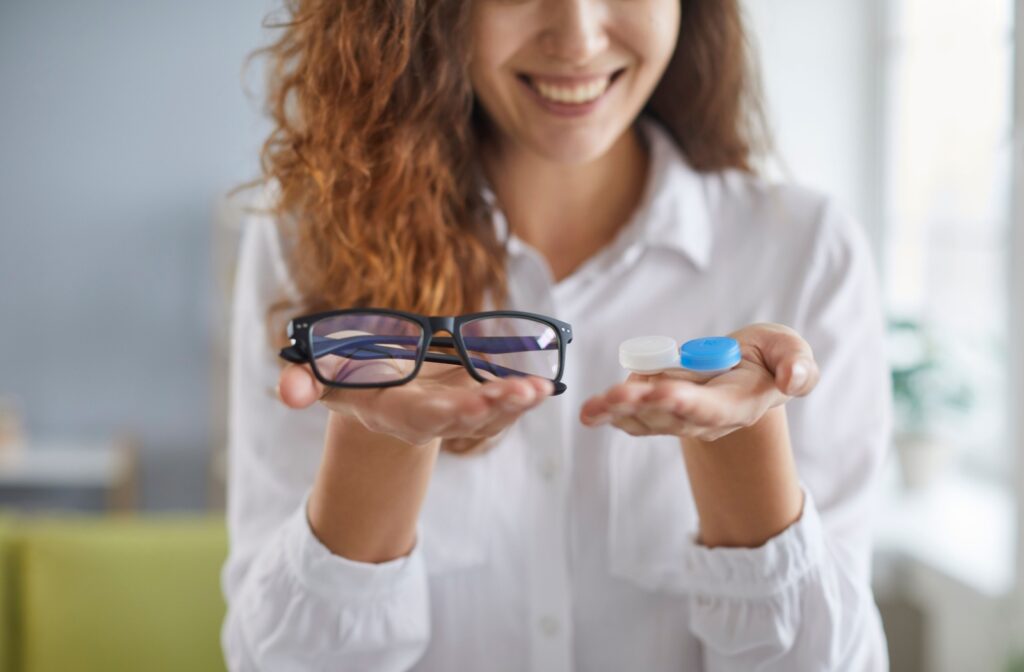
If you wear glasses and are thinking about trying contact lenses, you might assume that you can use the same prescription for both. This makes sense on the surface, after all, it’s the same set of eyes. However, as our team at Doctors EyeCare Grande Prairie can explain, these two prescriptions are not interchangeable.
The reason is simple: glasses sit a small distance away from your eyes, while contacts rest directly on them. This difference in distance requires two distinct prescriptions in order to give you clear and comfortable vision. That’s why you actually need a separate evaluation for each type of prescription. For contacts, this means a contact lens exam and fitting.
How Your Glasses Prescription Works
Think about where your glasses sit on your face. There’s a small gap, usually about 12 millimetres, between the lenses and your eyes. Your glasses prescription is calculated to focus light with this distance in mind.
You might see a plus (+) or minus (-) sign next to the sphere number on your prescription. A minus sign means you have nearsightedness, meaning that your near vision is clear, while your distance vision is blurry.
Key Measurements for Your Glasses
- Sphere (SPH): This number shows the main lens power you need to correct nearsightedness or farsightedness.
- Cylinder (CYL) & Axis: If you have astigmatism—an imperfection in your eye’s shape—these values correct the distortion it causes.
- Add: For those who need bifocal or progressive lenses, this number provides the extra power required for clear reading and close-up tasks.
What Makes a Contact Lens Prescription Different
Since contact lenses sit directly on your eye’s surface, additional measurements are needed. These include the fit of the lens and the size of your eyes. An improper fit can lead to irritation, blurry vision, or even eye health issues, so following contact lens safety guidelines is always recommended.
Contact lenses also come in various types, from soft daily disposables to monthly lenses or even rigid gas-permeable options. Each material allows different amounts of oxygen to pass through to your eye. The right choice for you depends on your lifestyle, eye sensitivity, and overall eye health.
Extra Details for a Perfect Fit & Feel
- Base Curve (BC): This measures the curvature of the back of the contact lens. It needs to match the curve of your cornea for a stable and comfortable fit.
- Diameter (DIA): This is the width of the lens from edge to edge. This measurement helps make sure that your contact lens properly covers your cornea.
- Brand & Material: Your prescription also specifies a brand of contact lens. Different materials affect how much oxygen reaches your eyes and how moist your eyes stay, so different brands are a good fit for different people.
The Key Difference: Lens Power & Distance
That small gap between your glasses and your eyes is the biggest reason why prescription powers aren’t the same. This space, known as the vertex distance, changes how your lenses affect your vision.
If you have a mild prescription, the lens power for your glasses and contacts might be similar. However, for stronger prescriptions, the situation is more complex, and the lens power can differ quite a bit between prescriptions.
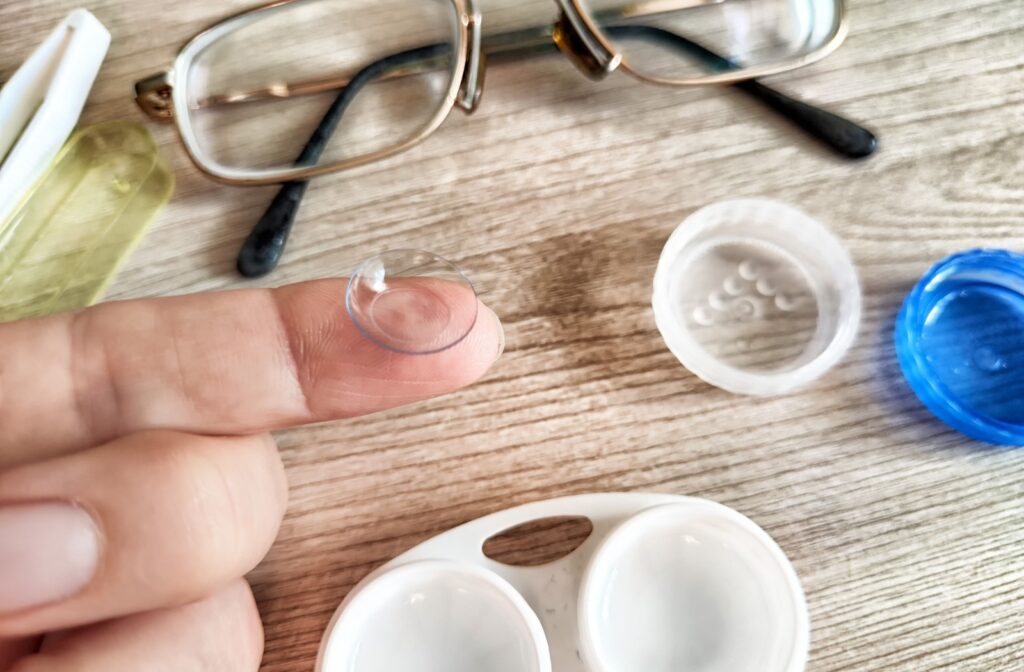
Why a Separate Contact Lens Fit Is Necessary
Getting contacts for the first time involves more than just a standard eye exam; it requires a dedicated fitting. During a contact lens fitting, the focus is on finding a lens that not only corrects your vision but also feels comfortable and safe for your eyes. Our team of eye doctors in Grande Prairie can help you through this process.
Part of this fitting process often includes trying a pair of diagnostic, or trial, lenses. This gives you a chance to see how the lenses feel and check their vision correction in a real-world setting. It also allows your eye doctor to assess the fit of the lenses and make any necessary adjustments before you order your supply.
What to Expect During Your Appointment
- An evaluation to check how the contact lens sits and moves on your eye.
- Instructions on how to safely put in, take out, and care for your lenses.
- A follow-up visit to confirm the lenses are working well for your vision and lifestyle.
The Bottom Line on Prescription Conversion
You cannot use your glasses prescription to order contact lenses, and the reverse is also true. The measurements for each prescription are different, and trying to convert them on your own can lead to poor vision and discomfort. Only an eye care professional can perform the tests needed to give you an accurate prescription, whether it’s for glasses or contact lenses. If you are curious about making the switch to contact lenses, the first step is to schedule a proper fitting. Book an appointment with our team at Doctors EyeCare, and let us help you determine the right option for your vision needs.